iTunes 7.1.1 Meets Vista Halfway

March 18th, 2007

As reported before, iTunes has a problem with Vista. The new iTunes version 7.1.1., released last week, which packs a lot of new features, fixes some of these problems, but not all. As I report in my other blog (iTimes), iTunes has been updated to accommodate Apple TV and provide full-screen cover browsing; incidentally, it doesn’t slam MusicMatch Jukebox against the wall anymore (see “iTunes Meets its MusicMatch“). iTunes version 7.1.1 “addresses a stability issue and minor compatibility problems” according to Apple. Most of these related to Vista. Apple also released QuickTime 7.1.5 which delivers numerous bug fixes and addresses critical security issues.

So far there have been no reports of trouble with the iTunes 7.1 update, other than Vista problems. People are mostly thrilled by the full-screen CoverFlow feature for browsing by album covers. It doesn’t yet show the track information on the flip side of an album cover (as demonstrated by Steve Jobs on the iPhone — see “iPhone Tips Revealed in Videos” in my iTimes blog) — that feature may come with the release of Leopard in June. Apple TV preferences are included in version 7.1, and QuickTime includes a setting for exporting to Apple TV. See my overview of iTunes version 7.1.1. features for a blow-by-blow description of cover browsing, managing multiple libraries, and using other new features of iTunes 7.1.1.

.Mac (Apple Computer, Inc.)

The Genuine Disadvantage of Windows

March 5th, 2007

Windows XP users — have you recently been “unable to complete genuine Windows validation”? You may be a pirate — or at least Microsoft thinks you might be. Then again you may just be a parrot. Don’t worry, Microsoft will figure it out.

The message is part of a controversial add-on to Windows XP, known as Windows Genuine Advantage Notification, which tells users whether Microsoft believes their copy of Windows to be legitimate (see “Windows adds ‘maybe pirate’ category” by Ina Fried in CNET News.com). It’s an antipiracy measure that will no doubt get in the way of many folks’ legitimate system operations and software udpates. Validation is required for most Windows XP downloads (though users can still get automatic security updates). As one CNET News.com reader commented, “If I ever see this pop up on one of our computers, I’ll fix the problem by installing Linux.”

If there’s a better example of why operating systems should either be completely free, or completely embedded in the hardware so as to be part of the product, I’d like to hear it. The many flavors of Linux are free (even if you purchase them on CD), so there is no such thing as a Linux pirate. The Mac OS X is essentially sold with the computer and unless you are going to pirate the hardware, you don’t get anywhere making pirate copies of the software — ain’t no percentage in it.

Microsoft said it hoped the new “yellow” state of we-think-you’re-a-pirate and Microsoft’s response that until-we-find-out-you’ll-hang-by-the-neck will somehow lead to better experiences for customers. Or something like that. How could you possibly trust Microsoft to figure out whether your copy is good enough to emerge from the “yellow” state? This is the company whose security services — Live OneCare — placed last in a test on the effectiveness of anti-virus security packages by Austrian researchers (see “Microsoft’s OneCare flunks anti-virus test” By John Leyden in The Register).

Of course, you would expect this: in Windows Vista, some features won’t work at all unless a machine is validated as genuine. Good luck with that.

Apple Store

Google Apps and Office Naps

February 23rd, 2007

Google introduced Google Apps Premier Edition for $50 per account per year. Think of it as the enterprise edition of Google Docs and Spreadsheets (which is what I use to write this blog, among other things), and competition for Office Live. The best thing about these types of Web applications (or Web services) is that the software is NYP — Not Your Problem. Software upgrades are implemented and bugs fixed without any need for you to install anything or mess up your computer with hidden files, dynamic link libraries, and drivers.

Google Apps Premier offers guaranteed uptime, IT management tools, technical support, increased email storage, and integration with the Docs and Spreadsheets word processing and spreadsheet applications, as well as BlackBerry support for Gmail (see “Google Apps upgrade threatens Office” by Juan Carlos Perez of IDG News). According to Dave Girouard, vice president and general manager of Google’s enterprise unit (quoted in the above story), Google plans to add several more applications to the suite before the year is out, and the JotSpot wiki service is a likely candidate.

Rafe Needleman of WebWare, writing for CNET News.com, tells us not to get too excited (see “Google Premium: Don’t get too excited“). Who’s excited? We’re just optimistic. Rafe points out that Google’s offering is not robust enough to give Office real competition… not yet, anyway:

The word processor and spreadsheet can’t exchange data, for example. The spreadsheet has no graphing function. And there’s no presentation program (Powerpoint competitor), although there are indications that Google is getting close to releasing one. On the other hand, Google’s communication and scheduling tools (Gmail, Google Talk, and Calendar) are very strong, and the mobile versions keep getting better as well… Here at Webware, we use Google Apps when we need to collaborate on documents, and sometimes when we need to bang out a quick story and don’t want to fire up a full Microsoft app. But it hasn’t replaced Office for day-to-day document creation. Yet.

Nevertheless, Google Apps is getting serious attention. Joe Wilcox in Microsoft Watch (”Google and Long Tail Computing“) makes the point that “Microsoft has a huge fragmentation problem, where businesses aren’t quickly upgrading to new versions of Office… These upgrade laggards form part of a Long Tail of computing that Google could capture as Apps customers.” Add all Mac users to the list as well. I’ve been a happy user of Google Docs since before Google acquired it (back when it was called Writely).

Wilcox’s newer post is also illuminating: “Google didn’t release ‘Apps’ to compete with Microsoft. Google’s objective is much bigger than Microsoft: A googol of information.” You know that old saw that “railroads are not in the railroad business, they are in the transportation business”? (Christy Hefner, CEO of Playboy, once used the phrase to describe the media business.) Wilcox points out that while Microsoft is in the “operating system” or software business, Google is in the “information” business. Microsoft monetizes software (and services, no doubt, in the future), while Google uses search and contextual advertising to monetize information. Give people just enough of a feature set and a lot of other things for free (a strategy Microsoft used in the 1990s with Office), and they will get on board. Meanwhile, Microsoft advances in services in the enterprise arena are hampered by its alliances with so many partners, which get much of their revenue from services that they sell on top of Microsoft software. As Google scales up to support enterprise customers, it begins to eat Microsoft’s lunch.

P.S. How a Typo Brought Down MS Office

According to the Wikipedia entry for googol, a very large number (actually 10 to the 100th power), Google was named after this number, but ended up with “Google” due to a spelling mistake on a check that investors wrote to the founders. While this bit of folklore will most likely survive challenges to its veracity as the history books dissect this period decades from now, David Koller at Stanford (who apparently was there) says that Larry Page’s officemate Sean Anderson was responsible for the misspelling — he executed a search of the Internet domain name registry database using “Google.com” by mistake, and found it available; Page liked the name and that was that. Of course, since Google didn’t exist at that time, there was no correction offered for Sean’s mistake.

Apple Store

The Last FairPlay Deal Gone Down

February 6th, 2007

It looks like Apple is serious about not licensing its FairPlay Digital Rights Management (DRM) technology used to protect music sold through its iTunes online store. Steve Jobs has put it all into perspective in an open letter on the Apple Web site. My more detailed blog post about this is in my new iPod and iTunes blog, Tony Bove’s iTimes — see “Let It Be… Naked (Without DRM)“.

The Vista Breaking Point

February 6th, 2007

As reported in my other blog, Tony Bove’s iTimes (”iTunes Pulls Over at Vista Point“), the iPod and iTunes software for Windows needs a patch to work with Windows Vista. But iTunes and the iPod are not the only media players, devices, and applications that break in Vista.

Three companies so far — Samsung, Cowon, and iRiver — have noted that a few of their players are incompatible with Vista (according to Gizmodo, each company will release new firmware to customers to update the players). Steven Warren writes in Window on Windows that his Sprint Wireless card, lacking a proper Vista driver, would not work unless he created a virtual machine of Windows XP to run it and access the Internet. He correctly identifies the culprit: the use, by many Windows XP applications, of the administrator user rights profile:

Prior to Vista, the default in Windows was to run as administrator. So vendors just programmed their software to work as a computer administrator with full user rights. The door was open; Microsoft’s lax security made writing code relatively simple for vendors. In fact, if you try to run as a limited user in Windows XP, for example, a lot of software will not work properly as Windows XP wasn’t truly designed to work this way… But the most talked about, under-the-hood change with the release of Windows Vista is its incredible improvement in security. And this has caused a challenge for vendors; they now have to rewrite their software to work as a user as opposed to an administrator.

After five years of propaganda and several months of beta, many vendors are still not ready for Vista. One might expect Apple to lag behind the others because it competes directly with Vista, but most other vendors don’t have that excuse — it’s the complexity of Windows security that costs these vendors delays. They would surely rather be making money selling products than spending money to make them work with new systems.

Thinking of upgrading to Vista and using your wireless Internet cards, music players, displays, and other devices that require software drivers? Good luck with that.

Don’t Play Vista For Me

January 30th, 2007

Microsoft Windows Vista has arrived. Hundreds (if not thousands) of blog entries are already posted about it. David Pogue of the New York Times pointed out that Microsoft has “deliberately exploited a weak spot in today’s court of public opinion: how bloggers influence consumers, but generally don’t have conflict-of-interest policies.”  He was referring to the news report that important bloggers had received Acer Ferrari laptops, which can sell for more than $2,200, from Microsoft. According to the New York Times, a spokeswoman for Microsoft confirmed that the company had sent out “about 90 computers to bloggers who write about technology and other subjects” to get them up to speed using Vista so that they can write their posts.

Well, here’s one blogger that didn’t get any free PC. Here are a few others — Fred Davis writes about a debate he participated in with Robert Scoble, Mac OSX vs. Windows Vista.

With eight editions of Windows Vista, one can expect confusion. If you eliminate the two specifically designed to cater to the European Union (with Windows Media technology removed) and the Starter edition for low-income countries (as defined by the World Bank), that leaves five. If you work at a large organization, chances are you’ll be using Windows Vista Enterprise, an edition available only through volume licensing deals for large organizations participating in Microsoft’s Software Assurance program. That leaves four. Of these, the least expensive (Home Basic) is not worth the effort for power Windows users, and the most expensive (Ultimate) and most desirable, at $399, is just too expensive. That leaves the Business and Home Premium editions, which are targeted to different types of customers.

And then there is the question of Vista’s touted security, even with the Ultimate edition. Webroot Software, as reported in The Guardian (”Virus warnings as Microsoft launches Vista” by Bobbie Johnson), announced that the new Windows Defender program failed to block 84% of viruses — including 15 of the most common pieces of malicious code. In any case, people who want to upgrade from Windows XP to Vista to improve security are in for a sticker shock. Only Windows Vista Ultimate — the most expensive edition — offers the maximum level of protection. Will the less expensive editions offer enough protection? Microsoft stands to gain from the confusion.

With Vista’s hardware requirements, upgrading an existing PC is problematic at best. But Vista is about buying a new computer. And you can bet that computer retailers are loading the less expensive versions. In fact, according to some reports, it is rare to find Vista Ultimate preloaded on new PCs. Dell, Gateway and HP charge $170, $160 and $120, respectively on top of what you already pay for Vista Home Premium.

So this is the choice Windows user have? “Upgrading to Vista is pretty expensive, not only the new software but often new hardware as well,” said Gartner analyst John Pescatore in “Experts: Don’t buy Vista for the security” by Joris Evers (CNET News.com). “If you put IE 7 on a Windows XP SP2 PC, along with the usual third-party firewall, antiviral and antispyware tools, you can have a perfectly secure PC if you keep up with the patches.”

If you keep up with the patches… Good luck with that!

P.S. Apple offers one desktop version of Mac OS X at a single price for individual copies. You pay $129 and get it all, compared to $399 for Windows Ultimate.

Calculating with Incense and Spreadsheets

January 27th, 2007

It should come as no surprise to learn that the inventors of the spreadsheet and the first companies to market spreadsheet software were refugees from the Sixties counterculture. How often have you looked at a spreadsheet and thought, what were they smoking?

Before computers, paper ledgers were trusted because they weren’t so complicated that you couldn’t recalculate them by hand. But spreadsheets are far more complex, especially ones created in Excel that use multiple worksheets. The truth is a formula you can plug into a spreadsheet cell and never see again, nor question. Rows and columns of numbers seem accurate — but who really knows? You have to trust the spreadsheet maker and the program that made it, including its automatic formulas. But as spreadsheets proliferate through a company without any means of updating their information, they become multiple versions of the truth.

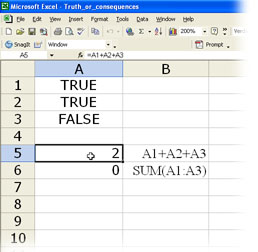
You want truth in a formula? Consider this spreadsheet:

Image of Excel spreadsheet

Truth depends on what formula you use. The cell range A1:A3 contains Boolean values (TRUE or FALSE). Add them up one way you get 2; add them up with the SUM function and you get 0.

The formula in cell A5 uses the addition operator. The sum of these three cells is 2. The conclusion: Excel treats TRUE as 1 and treats FALSE as 0. Except that it doesn’t: the formula in cell A6 uses Excel’s SUM function. In this case, the sum of these three cells is 0.

Note that OpenOffice.org Calc, an alternative, provides the correct answer — 2.

OpenOffice.org Calc, part of the free OpenOffice.org suite, offers the same set of analysis and graphic tools as Excel. OOo Calc runs on Windows, Linux, Sun Solaris, and Mac OS X, and can open and save spreadsheets in all Microsoft Office formats as well as the standard XML format.

Microsoft grudgingly accepts the fact that there are alternatives to Excel and lets you save worksheets and entire workbooks into some of the more popular formats with the formulas and calculations, sometimes even the formatting. Of course, every time you do this, Excel warns you that you may lose something in the process. The WK4, WK3, and FM3 formats for Lotus 1-2-3 work fine, but beware of Microsoft’s XML: You can save the entire workbook in this format, but you lose any charts and graphs, macro sheets, custom views, drawn object layers, outlines, scenarios, shared workbook information, Visual Basic projects, and user-defined function categories. You also can’t save password-protected worksheets. Good luck with that.

Storm Hits Home

January 23rd, 2007

This is one to watch. And didn’t I warn you? The “Storm Worm” (as dubbed by F-Secure), which started in Europe during the onslaught of a real storm, has spread all over the world, affecting more home computers than business computers due to the fact that most businesses block attachments to emails (see “‘Storm Worm’ Trojan horse surges on” by Tom Espiner, Special to CNET News.com). People who open the attachment then unknowingly become part of a botnet. A botnet serves as an army of commandeered computers, which are later used by attackers without their owners’ knowledge.

The attachment is an executable file that opens a backdoor in a Windows XP PC and installs a rootkit (not unlike the infamous Sony rootkit) that hides the malicious code. The compromised PC becomes a zombie in a network called a botnet. While many botnets are centrally controlled and can be brought down by destroying the central server, the Storm Worm botnet acts like a peer-to-peer network with no central control.

According to the CNET News.com report, antivirus vendor Sophos called Storm Worm the “first big attack of 2007,” with code being spammed out from hundreds of countries.

Is Microsoft mobilizing its forces to stop these botnets? Not really. In the reality distortion field created by Microsoft that covers most of the planet, everyone should be merrily switching to Vista. So Microsoft is moving quickly to capture the antivirus share of the global Vista market with OneCare.

Think you can give your Windows XP PC shelter from this storm? Good luck with that.

Pay Up! For the Vista Content Protection Racket

January 21st, 2007

On the Sopranos, the Mafia controls the docks, the garbage trucks, the cops, the judges — the very infrastructure of the lives of those who live in Jersey. You can’t get anything in or out without their “help” and protection. Well folks, thanks to Microsoft, our content will live in a cyberspace Jersey.

Microsoft Vista includes Digital Rights Management (DRM) technology that acts as an enforcer with regard to protected content: it will shut down worldwide any equipment connected to Vista that is suspected of enabling a breach of content protection, and disable playback of anything that smells of protected content on equipment not sanctioned by Microsoft. I am not making this up.

An extensive report on Vista DRM-atology — “A Cost Analysis of Windows Vista Content Protection” by Peter Gutmann in New Zealand — describes in detail how Vista’s DRM has turned into Hollywood’s Offer That You Can’t Refuse. Here’s a quick summary:

A protection racket for Microsoft’s Vista-licensed manufacturers. Vista stops protected content from playing on devices that don’t have Vista DRM content-protection facilities built in. What, you just bought high-end audio equipment that uses the currently popular S/PDIF (Sony/Philips Digital Interface Format) standard? Fuhgeddabout It! You won’t be able to use it with Vista and protected content. Here’s how Gutmann describes it:

Once a weakness is found in a particular driver or device, that driver will have its signature revoked by Microsoft, which means that it will cease to function (in informal terms, your device gets bricked, i.e. turned into a brick)… What this means is that a report of a compromise of a particular driver or device will cause all support for that device worldwide to be turned off until a fix can be found. If it’s an older device for which the vendor isn’t interested in rewriting their drivers (and in the fast-moving hardware market most devices enter “legacy” status within a year or two of their replacement models becoming available), all devices of that type worldwide become permanently unusable… If a particular piece of hardware is deactivated (even just temporarily while waiting for an updated driver to work around a content leak) and you swap in a different video card or sound card to avoid the problem, you risk triggering Windows’ anti-piracy measures, landing you in even more hot water.

A protection racket for protected content producers (Hollywood). Vista requires that any interface that provides high-quality output degrade the signal quality that passes through it if premium content is present. What, you expect your high-resolution monitor to show a crisp image? Fuhgeddabout It!  According to Gutmann:

This is done through a “constrictor” that downgrades the signal to a much lower-quality one, then up-scales it again back to the original spec, but with a significant loss in quality. So if you’re using an expensive new LCD display fed from a high-quality DVI signal on your video card and there’s protected content present, the picture you’re going to see will be, as the spec puts it, “slightly fuzzy”…  The same deliberate degrading of playback quality applies to audio, with the audio being downgraded to sound (from the spec) “fuzzy with less detail”. Amusingly, the Vista content protection docs say that it’ll be left to graphics chip manufacturers to differentiate their product based on (deliberately degraded) video quality. This seems a bit like breaking the legs of Olympic athletes and then rating them based on how fast they can hobble on crutches.

An endless scenario of security threats and reliability problems. Vista tries to detect hacks by looking for abnormalities in the hardware. Any little glitch that previously would have caused no change in operations — such as a voltage fluctuation or slight change in bus signals, or an unusual return code from a function call — can cause a system restart. What, you thought your Vista system would be more reliable, and that you wouldn’t need to pay more for protection? Fuhgeddabout It! Gutmann says:

Starting up or plugging in a bus-powered device may cause a small glitch in power supply voltages, or drivers may not quite manage device state as precisely as they think. Previously this was no problem — the system was designed with a bit of resilience, and things will function as normal. In other words small variances in performance are a normal part of system functioning. Furthermore, the degree of variance can differ widely across systems, with some handling large changes in system parameters and others only small ones… With the number of easily-accessible grenade pins that Vista’s content protection provides, any piece of malware that decides to pull a few of them will cause considerable damage. The homeland security implications of this seem quite serious, since a tiny, easily-hidden piece of malware would be enough to render a machine unusably unstable, while the very nature of Vista’s content protection would make it almost impossible to determine why the denial-of-service is occurring… Even without deliberate abuse by malware, the homeland security implications of an external agent being empowered to turn off your IT infrastructure in response to a content leak discovered in some chipset that you coincidentally happen to be using is a serious concern for potential Vista users.

A distribution channel controlled by Microsoft. The only reason Microsoft would go to all this trouble to set up such a restrictive DRM scheme is to completely own the channel and dictate terms to device manufacturers, content publishers, and consumers. Want an open alternative to the closed Apple iTunes model? Fuhgeddabout It!  According to Gutmann:

Not only will [Microsoft] be able to lock out any competitors, but because they will then represent the only available distribution channel they’ll be able to dictate terms back to the content providers whose needs they are nominally serving in the same way that Apple has already dictated terms back to the music industry: Play by Apple’s rules, or we won’t carry your content. The result will be a technologically enforced monopoly that makes their current de-facto Windows monopoly seem like a velvet glove in comparison.

So what has been the response to all this (besides a very funny cartoon by Philip Dorrell)?


Robert X. Cringely would have us all keep a stiff upper lip. “Digital Rights Management is really just an ecosystem for selling our own stuff to us again and again,” he points out in the I, Cringely column “Feeding Frenzy“: You should just get out your wallet. Vista is “entirely about getting people to buy new computers and that any lip service to upgrading current equipment is just that, lip service…”

If you want a Windows Vista media PC to deliver high-quality video and audio with no driver problems, just buy a new Windows Vista media PC from some big vendor like Dell, HP, or Sony and match it with other big-vendor stereo and video components that use strictly DRM-preserving HDMI connectors and therefore create no points of signal degradation along the path from hard disk to eye or ear.”

And yet, I agree with Cringely that Microsoft will ultimately not be successful, for two reasons:

Vista DRM will be cracked quickly. Cringely puts it best:

Vista [DRM] will fail because the job it is attempting to do is too hard, because Microsoft isn’t especially good at these huge integration jobs, and because there is a smart hacker community determined to break Vista [DRM] over and over again, which it will.”

Microsoft relies too much on Hollywood. Many of Vista’s DRM technologies exist because large movie studios, record labels and cable television networks want them. Meanwhile, user-generated content is on the rise while Hollywood’s content is becoming less important. The new content providers that gave YouTube its popularity, and the social networks that provide measurable niche markets, will have no use for DRM.

Matt Rosoff, lead analyst at research firm Directions On Microsoft, thinks that Vista DRM does not bode well for new content formats such as Blu-ray and HD-DVD, neither of which are likely to survive their association with DRM technology. As quoted in Computerworld’s “Vista and More: Piecing Together Microsoft’s DRM Puzzle” by Matt McKenzie, Rosoff says Vista DRM is “so consumer-unfriendly that I think it’s bound to fail — and when it fails, it will sink whatever new formats content owners are trying to impose.”


Notes from the Liberty Front

November 28th, 2006

The French government is saying no to Microsoft (see “French parliament dumping Windows for Linux” By Christophe Guillemin, Special to CNET News.com). While institutions such as the Minstry of Agriculture have already adopted Linux servers and the gendarmerie uses OpenOffice and FireFox, the decision by the French National Assembly is the first case of a French public institution switching its PCs to Linux.

Munich, Germany, started saying no to Microsoft back in 2003 and has finally implemented this plan (see “Munich fires up Linux at last” by Richard Thurston, Special to CNET News.com). Microsoft CEO Steve Ballmer interrupted his ski vacation to stop by the Mayor’s office in Munich and stop the migration, but the city is moving forward with Linux PCs (using Debian). Mannheim, Germany, is also saying no, migrating 3,500 desktops to OpenOffice running on Linux (see “One city’s move to open source” by Ingrid Marson,
Special to CNET News.com).

In Bergen, Norway, the planned desktop Linux migration will not happen for at least two years (see “Pioneering desktop Linux project put on ice” By Graeme Wearden, Special to CNET News.com). However, the city is jumping headlong into Web services with an e-government portal to give citizens better access to services — running, of course, on Linux servers.

In Kerala, India’s most literate state, children in 12,500 high schools will switch from Windows training to Linux training (see “Kerala logs Microsoft out” by M Sarita Varma, The Financial Express).

Venezuela has decided that there oughta be a law: starting in January (2006), their new free software law, directive 3.390, comes into effect, which mandates all government agencies to migrate to free software over a two year period (see “Free software liberates Venezuela” By David Sugar, Free Software Magazine).

In plenty of other countries and cities, mandated or not, Linux desktop PCs are decisively replacing PCs. Government contracts are typically profitable for companies like Microsoft — these moves may kick off a trend that will hurt the company.